
- September 1, 2026
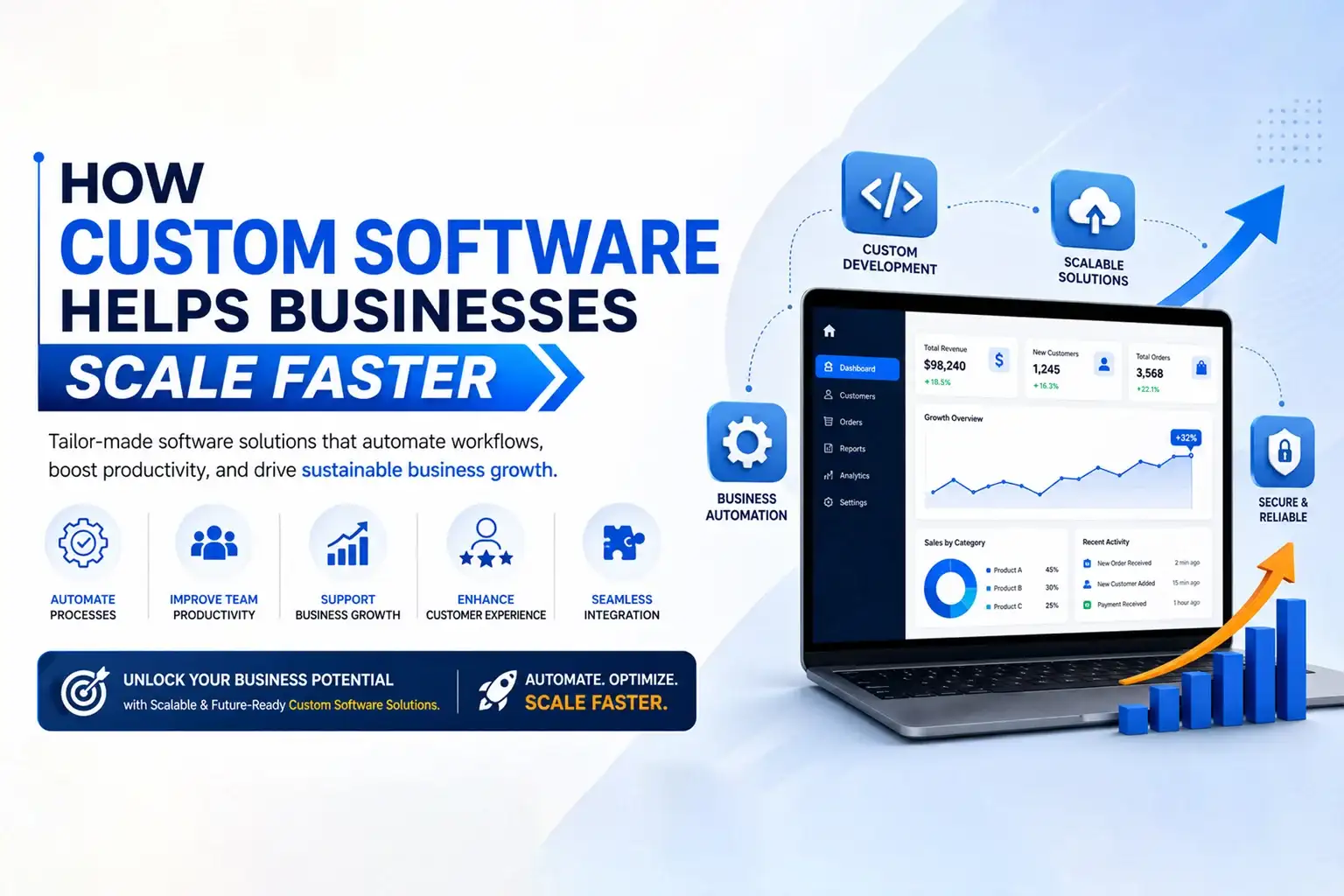
As a business grows it will hit a stage at which out of date processes, separate systems, and generic software start to put the brakes on progress. What was sufficient for a small team before often becomes a choke point as we scale up, customer demands go up, and processes become more complex.
Many companies turn to off the shelf software at first for which it is cheap and easy to implement. But as businesses grow out of that stage these solutions which we see are a one size fits all do in fact fall short of what the business requires. Teams end up using a variety of tools, we see them maintain duplicate data and spend lots of time on repetitive tasks.
This is the area where custom software development comes into its own. We see that off the shelf applications do not fit companies’ particular workflows, goals and growth strategies. What we find is that which is spent on made to measure technology pays off in terms of increased efficiency, better customer interaction, and faster scale.
In this article we will look at how businesses benefit from custom software in which they see growth faster, solve operational issues, and achieve long term success.
What Is Custom Software Development?
Custom software development is a process which we design, build, and maintain software applications for the exact needs of a business. Instead of making business operations fit into a preexisting software framework we build solutions that go around your present work flows and what you are trying to achieve.
These we developed to address specific business issues and which also support growth. We don’t create software for the general public, instead our custom solutions are tailored to a company’s needs.
Examples of custom business software include:
- – Customer Relationship Management (CRM) systems
- – Enterprise Resource Planning (ERP) platforms
- – Inventory management systems
- – Online booking systems
- – Customer self-service portals
By putting resources into business software development organizations achieve full control of features, functionality and future improvements.
Why Off-the-Shelf Software Limits Growth
Off the shelf software may appear to be a simple choice at first, but it often ends up putting in constraints as a company grows. By which which I mean to say that which custom software does better we put this out there for decision makers to use in better technology investments.
Unnecessary Features
Most commercial software products cater to large audiences. Also it is the case that companies pay for features which they do not use. These extra elements in the software can complicate workflows and reduce efficiency.
Monthly Subscription Costs
Subscription based software may seem affordable at first. But as teams grow and more users are added in, the monthly fees go up.
Limited Integrations
Many companies use a variety of solutions for sales, accounting, marketing and customer support. Off the shelf software may not play well with current systems which in turn results in data silos and operational inefficiencies.
Workflow Restrictions
Each company is different. Off-the-shelf software tends to put employees in pre determined workflow models which do not always support how the business really works.
Data Ownership Concerns
Some third party which is what we see in the case of some services has issues with access to very important business information and also they are not the best for migration. Also we see that for some companies which require more flexibility and control this is a challenge.
How to use Custom Software to scale your business faster.
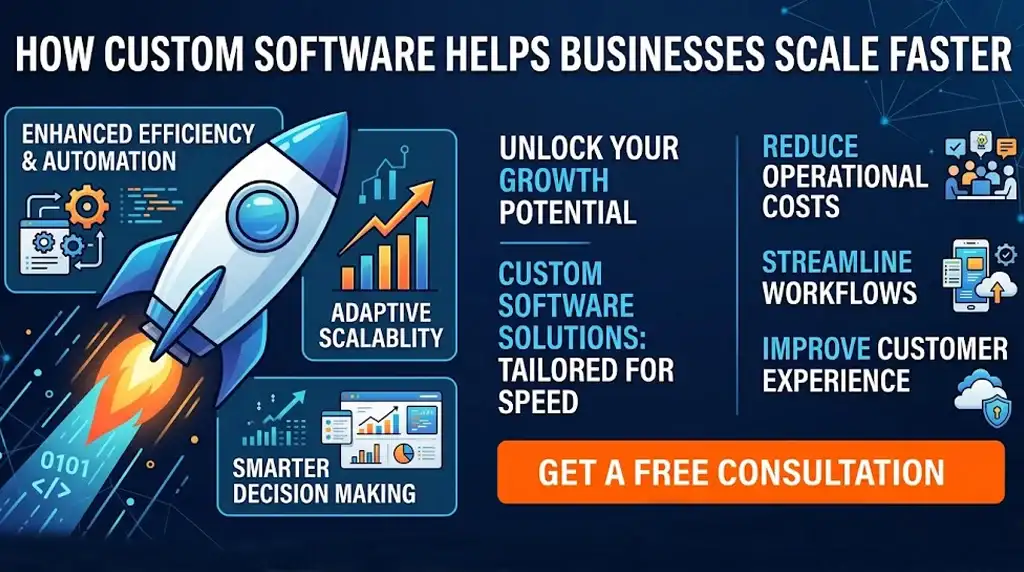
Custom software development’s greatest asset is that it supports growth without at the same time creating operational issues. We design our applications with scale in mind which in turn allows businesses to grow efficiently.
Automates Repetitive Tasks
Manual processes take up a great deal of time and also see an increase in human error. In which of software and business process automation companies are able to eliminate routine tasks and at the same time improve performance.
Examples include:
- – Automated invoice generation
- – Lead management workflows
- – Customer onboarding processes
- – Inventory tracking
- – Reporting and analytics
When staff put in less time to routine tasks they may put more into growth oriented projects.
Improves Team Productivity
Productive output sees great growth when we provide to staff tools that are tailored to their day to day tasks.
In a centralized environment teams are able to access info quickly, to collaborate better, and to reduce unnecessary communication delays. Also we see that custom software which is used minimizes duplicate data entry and manual paperwork.
Benefits
- – Faster workflows.
- – Better collaboration.
- – Improved accuracy.
- – Higher efficiency.
These benefits fuel business growth.
Supports Business Growth
Companies that put into scaleable software do so because of the software’s ability to grow with the business.
As customer base increases businesses see the need for systems which handle greater workloads without issue. We are seeing that custom software which is designed with flexibility in mind does better in the long run as it is easy to upgrade and expand as requirements change.
Businesses can:
- – Add new features
- – Expand to new markets
- – Manage larger customer bases
- – Launch additional services
- – Support multiple locations
This adaptability is what makes custom software a great growth investment.
Better Customer Experience
Customer which is the ever aware of what’s next, see the sky touch the bar we set. Which means that in today’s world if you are able to provide personal and quick solutions to their issues your business will outdo it’s competitors by large.
Custom built software applications can improve customer satisfaction by:
- – Personalized dashboards
- – Self-service customer portals
- – Faster support systems
- – Automated communication
- – Customized user experiences
A better customer experience results in greater loyalty, higher retention, and more revenue.
Easier Integration with Existing Tools
Today’s businesses use a variety of technologies for smooth operation. We also see custom software which is designed to integrate with present platforms very well.
Common integrations include:
- – Payment gateways
- – Accounting software
- – Marketing automation tools
- – CRM systems
- – E-commerce platforms
Smooth implementation of systems which in turn removes data duplication and improves visibility between departments.
Real-World Examples of Custom Software
Example 1: Online retail business.
An online retailer had issues with inventory management which crossed over multiple sales channels. They implemented custom inventory software which in turn automated stock synchronization and order processing.
The results saw speedier fulfillment, reduced inventory errors, and improved customer satisfaction.
Example 2: Healthcare Provider.
A health care provider required a secure patient management system which complied with industry regulations. Which they achieved via enterprise software development they created a custom platform that improved patient scheduling, medical record keeping and communication.
This saw administrative loads go down and improved patient care.
Example 3: Logistics Company.
A logistics company had issues with shipment tracking and delivery routes. We implemented a custom tracking solution which provided real time info, route optimization, and automated reports.
The firm increased operational efficiency and at the same time reduced transport costs.
Industries Which See the Greatest Value in Custom Software.
Almost all industries see benefits from custom software solutions but some do in much larger degree.
Healthcare
Healthcare providers need secure and compliant systems which support patient care and operational efficiency.
E-commerce
Online retailers require systems which scale to perform order fulfillment, manage inventory, process payments, and engage with customers.
Logistics
Transportation companies profit from route optimization and fleet management as well as shipment tracking.
Education
Educ many schools have created their own platforms for education, communication between students, and admin.
Finance
Financial institutions need secure systems for transactions, compliance, and customer management.
Real Estate
Custom made software solutions for property management, lead tracking, and client communication.
SaaS Startups
Startups use custom software development for their unique products and competitive edge.
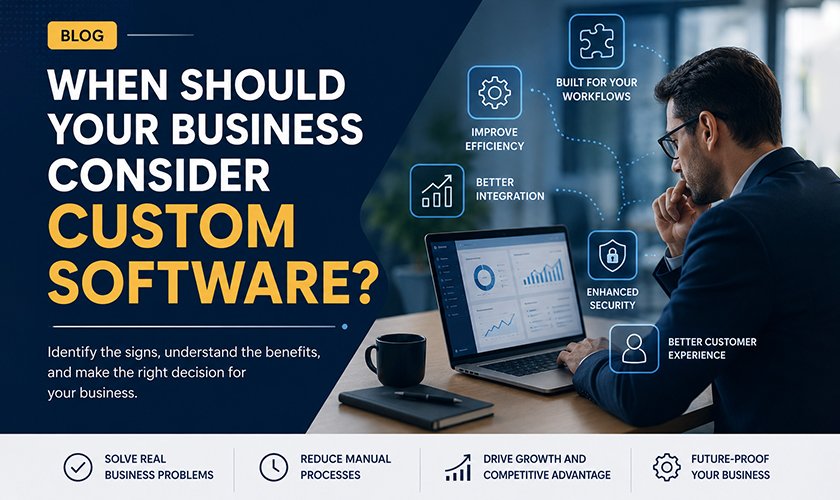
Signs Your Business Needs Custom Software
Many companies are still using out of date systems which by now should have been replaced. If you see any of the following signs it may be time to look into custom business software:
- – Too many manual processes
- – Multiple disconnected software tools
- – Frequent workflow bottlenecks
- – Growing customer demand
- – Difficulty accessing business data
- – Increasing operational complexity
- – Poor system scalability
- – Repetitive administrative tasks
These issues point out that present software is a brake to growth instead of a support.
Cost vs Long-Term Value
One of the primary issues with custom software development is that of initial investment. Although custom software may have a greater up front price tag compared to off the shelf solutions, in the long term the value does pay off.
Businesses benefit from:
- – Lower operational costs.
- – Improved efficiency.
- – Greater productivity.
- – Reduced software subscriptions.
- – Better scalability.
- – Higher return on investment.
Unlike generic solutions our custom applications grow with your business’ needs which in turn reduces the need for expensive rehypes in the future.
When looking at technology investments companies should think of total value instead of initial cost.
Selecting the Best Custom Software Development Team.
Picking the right development partner is key to project success. A solid software development company will have knowledge in both technology and business strategy.
Experience
Look out for companies that have proven experience in many industries and projects.
Technology Expertise
Ensure your development team is well versed in modern tech and frameworks.
Scalability Focus
Software which scales with growth.
Support and Maintenance
Continuous updates, technical support, and performance monitoring are key to long term success.
A robust development partner is a key to turning business requirements into large scale digital solutions for sustainable growth.
Conclusion
Business growth introduces which in turn see greater work loads, operational complexity, and also higher customer expectations. At the start we may see off the shelf software work but as companies grow this solution often becomes a limitation.
Custom-developed software is what you need for success in the long term. We see improved productivity, better customer experience, smooth integrations, and automated business processes, which in turn enable companies to grow more efficiently.
Companies that put investment in custom software see that, which translates to outperformance of the competition, improved flow in operations, and looking ahead technology.
Looking for software that is designed to meet the unique needs of your business? We’d love to chat with you about your project and also present to you how we can scale your business with our software solutions.
 Frequently Asked Questions