
- August 28, 2026
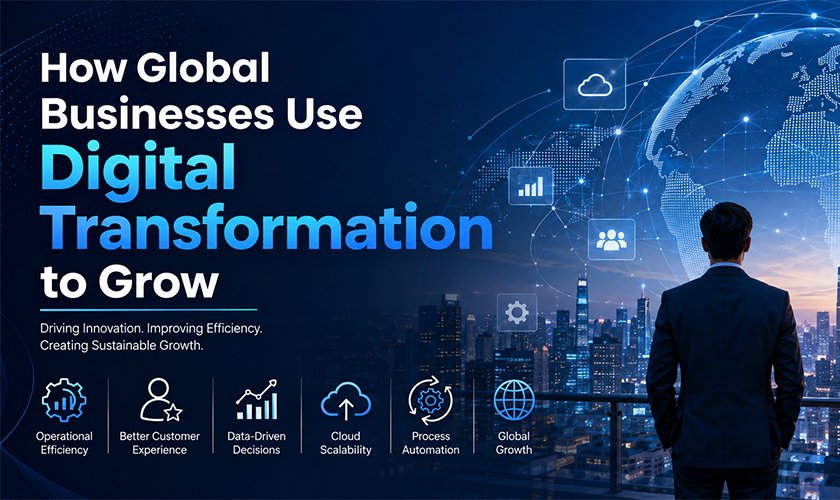
Digital transformation is a key growth strategy for companies in the global competitive arena. Also, they are not just for the betterment of the systems but are using digital instruments to enhance the customer experience, improve internal processes, make quick decisions, and also identify new sources of revenue.
From software solutions and AI to automation, data analytics, and custom software, digital transformation is a tool that helps companies build more flexible and scalable businesses. For global businesses that have customers, employees, suppliers, and operations in many regions, technology enables better connection and response to change in the market.
What Is Digital Transformation?
Digital transformation is what a company does to adopt present digital technologies, which in turn improves how it runs and what it puts out to its customers. This may include overhauling legacy systems, putting in place automation for repeat tasks, adopting cloud-based solutions, enhancing digital interaction with customers, or using data to make better business choices.
Importantly, we see that digital transformation goes beyond the purchase of new technology. Rather, it is in how technology is aligned with business goals and supports long-term business growth.
For instance, a global retailer may use an integrated e-commerce platform as well as customer analytics, inventory management software, and automated marketing in which to present a better customer experience. In the case of a service business, they may use cloud-based collaboration tools and develop custom applications for improved coordination of teams that span multiple countries.
Enhancing Operational Efficiency
One of the primary benefits of digital transformation is better operational efficiency. Global companies that may run complex processes in many departments, locations, and time zones.
Manual processes introduce delays, put up costs, and also see human error. Digital tools, which in turn allow businesses to automate repetitive tasks and connect info across departments.
For instance, automated workflows also do processing of invoices, alerting customers, reports generation, employee requests, and data input. Also, employees can put in that extra time for strategic tasks instead of routine admin work.
Custom-made software can be designed for a company’s specific workflow instead of that company, which has to adapt to a generic system. This type of software development can help businesses create solutions that better match their operational requirements.
Improving Customer Experience
Customer expectations have transformed as we have integrated digital services into our daily lives. Today customers expect companies to offer quick response times, easy online access, personalization, and information at the touch of a button.
Global companies that are seeing success from digital transformation, which they are using to present the same experience to customers no matter what digital platform they are on, whether it is the website, mobile app, social media, or any other digital channel.
A present-day website may put at ease the customer with relevant info and easy navigation; also, mobile apps may put forward personal services and direct communication. Customer relationship management: we see to it that businesses do indeed get to know their customers’ interactions, which in turn improves future engagement.
In the area of digital strategy, which is where effective Digital Experience Design in particular plays a key role.
Using Data to Improve Outcomes
Data is a key resource for today’s business world. We see info generated from websites, apps, sales platforms, customer touch points, marketing strategies, and internal processes.
Digital transformation is that which sees companies improve how they collect, organize, and analyze this info.
Instead of using assumptions, which are guesses, business leaders may use analytics to see trends, know what customers do, measure how we are doing, and also find out about issues that may arise.
For instance, a business that is in the e-commerce space may look at purchase data to determine what products do the best in various markets. Also, marketing teams may study campaign results and improve their strategies based on what is proven to work.
Data-based decision-making, which in turn sees global businesses become more responsive and strategic.
Scaling Up with Cloud Technology
Cloud-based systems have enabled businesses to grow their digital infrastructure at a faster rate with less investment in physical hardware.
Global corporations can have at their disposal cloud-based systems, which give access for employees to applications and info from any location. This in turn supports remote work, international teams, and entry into new markets.
Cloud platforms also present a solution for scaling up computing resources as demand grows. For instance, a company that is rolling out a new digital service can scale its infrastructure according to traffic and use.
This is a great asset for companies that must adapt to market changes quickly and continue supporting business growth.
Automating Routine Tasks
Automation is a key piece of digital transformation. We see in which companies outsource to machines processes that are repetitive, time-consuming, or that follow very set rules.
Examples include:
- Automated customer emails
- Invoice processing
- Data synchronization
- Appointment scheduling
- Marketing workflows
- Internal reporting
- Customer support processes
Automation is a tool which reduces repetitive manual tasks at the same time it helps organizations to maintain greater process consistency.
When we combine the power of artificial intelligence into automation, that is when we see true synergy. AI based systems may be used for customer support, data analysis, content workflow, forecasting, and other business processes.
Supporting International Cooperation
International companies require that employees and teams work as a unit which is regardless of where they are based. Digital transformation brings in tools for better communication, collaboration, file sharing, project management and also for access to info.
Cloud based collaboration tools which allow employees to access key resources from any location. Also integrated systems may put an end to departmental information silos.
In global businesses improved collaboration increases productivity and also enables teams to react faster to customers and business opportunities.
Building Out Competitive Advantages
Digital transformation also allows companies to stand out from the competition.
Companies which put technology to good use may roll out new services, improve present products, cut operational costs, and react faster to what customers want.
For instance a business may develop a tailor made mobile app which does not present in competitors’ product lines. Also we see companies which use analytics for personalizing customer experience or automation to provide faster service. Mobile app development can therefore support businesses that want to create more direct digital experiences for their customers.
Technology by itself is not always an edge. What gives that edge is how well a company uses tech to solve business issues.
Improving Business Flexibility
Markets shift rapidly due to customer preferences, economic conditions, emerging technologies, and new competitors. Companies with out-of-date systems may have trouble in that regard.
Digital transformation sees companies become more agile through the implementation of flexible systems and improved processes.
In a setting of centralized info and digitalized processes, businesses are able to notice changes, which in turn allows them to adjust strategies.
This quality is of great importance to multinational companies, which may find that in different markets customers’ expectations and competition vary.
Developing a Long-Term Digital Strategy
Digital transformation is a continuous process that is to grow with business and tech changes.
Companies must first put out what their greatest operational and customer issues are. From which they can choose which technologies to invest in that provide proven business value.
A successful digital transformation may see:
- Assessing existing technology and processes
- Identifying operational challenges
- Defining measurable business objectives
- Selecting suitable digital technologies
- Training employees
- Implementing solutions in stages
- Measuring performance
- Continuously improving systems
This approach allows companies to not put into use technology just because it is the latest or in trend.
The Role of Technology Partners
For most companies digital transformation is an issue. We see that technology partners, which bring to the table expertise in software development, cloud solutions, mobile apps, UI/UX design, automation, and digital strategy, are very valuable.
The right partner will help a business in identifying their needs, choosing the best technologies for the job, and developing tailored solutions, all of which we see as an enhancement of present digital infrastructure.
For companies looking at renovation of their processes, Enterprise Web Solutions may be a piece of a large digital transformation.
Conclusion
Digital transformation is seeing global businesses become better at what they do, at knowing and serving their customers, at using data and in terms of flexibility. We see in automation, cloud technology, custom software and digital experiences which tools that are used to address business issues and to put in place for sustainable growth.
Also, what we see as successful transformation is not in the adoption of every new tech out there. It is in identifying what the business needs are and putting in the right solutions which add measurable value.
As markets become more competitive worldwide, companies that develop a flexible digital strategy will see they are better able to react to change in customer needs and opportunities.
 Frequently Asked Questions