
- By hassamullah000@gmail.com
- August 3, 2026
As companies scale, they find that management of day-to-day functions becomes more complex. We see that they are dealing with greater volumes of data, many different departments, customer requests, issues related to inventory, financial matters, and internal processes. Also, it has been noted that the software solutions we put in place are not always flexible enough or give the control that businesses require to run smoothly.
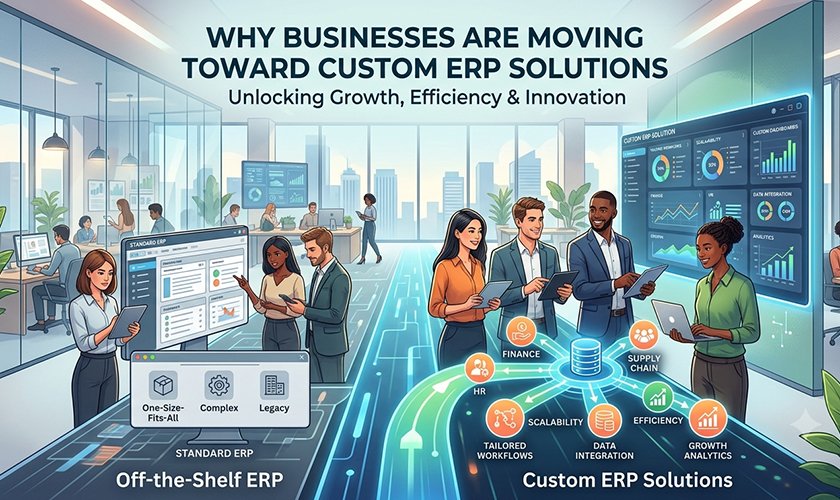
This is why many organizations are going to custom ERP solutions that are designed according to their unique business requirements. We see that what is different is the fact that custom ERPs do not present a set of fixed features, which the former standard ERP platforms do. Instead custom ERPs are tailored to a particular company’s workflows, goals, and operational needs.
A properly built custom ERP solution, which in turn sees companies’ productivity increase, process automation take place, better decisions made, and a scalable base for that which supports growth over the long term. Also reports of which we have had those firms that put into a custom ERP, which in turn report they have more control of their operations, with at the same time the issue of inefficient interconnected systems reduced.
What Are Custom ERP Solutions?
Custom ERP Systems are business oriented resource planning solutions which we develop to fit a company’s specific needs. ERP software brings together various departments and processes into one central platform which in turn allows organizations to improve their operation.
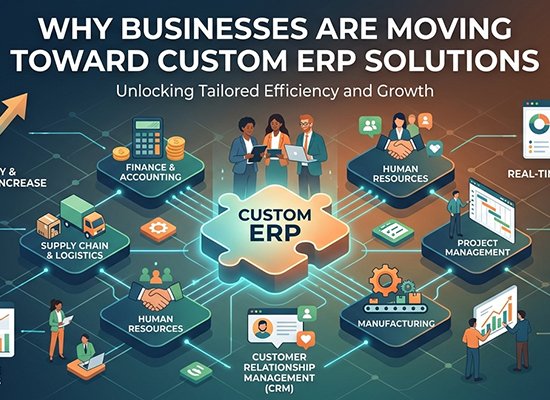
A custom ERP system can include modules such as:
-
- Financial management
- Inventory management
- Human resource management
- Customer relationship management
- Supply chain management
- Project management
- Sales and reporting
- Business analytics
- Workflow automation
Instead of adjusting business processes to match existing software limitations, companies can use a custom ERP system that adapts to their existing workflows.
Why Businesses Are Choosing Custom ERP Solutions
1. Better Alignment With Business Processes
Every business runs on different systems. A manufacturing firm, health care provider, retail chain, or service-oriented company has its own issues.
Off-the-shelf ERP solutions tend to have too many unnecessary features and not enough of what a business needs. This in turn increases customization costs, and we see staff adopt new work methods.
Through custom ERP software development, businesses get a system that is tailored to their exact processes. We create each feature, module, and workflow around your specific goals.
This increases efficiency, which in turn sees teams finish tasks with less complication.
2. Improved Business Process Automation
Manual processes tie up time and also see an increase in mistakes. Also many organizations which run their operations through sheets or separate tools report to struggle with routine tasks.
Custom ERP systems automate important business activities, including:
- Invoice generation
- Inventory updates
- Employee management
- Reporting processes
- Data entry
- Customer communication
- Approval workflows
Through automation, employees can focus on strategic tasks instead of spending hours managing repetitive operations.
3. Centralized Data Management
One of the biggest challenges businesses face is managing data across multiple platforms. Different departments often use separate systems, creating information gaps and communication problems.
A custom ERP solution brings all business data into one centralized platform.
Employees can access:
- Real-time business information
- Financial records
- Customer data
- Inventory details
- Performance reports
- Operational insights
Centralized data improves collaboration between departments and helps management make faster, data-driven decisions.
4. Enhanced Scalability for Growing Businesses
As companies grow, business needs change. What may be a functional software system today could tomorrow be insufficient for that growth.
Scalable ERP systems that grow with your business’ needs. As your business changes, so do our solutions, which in turn add on more features, users, departments, and integrations.
Whether a company grows into new markets, adds to its staff, or introduces new services, it may roll out a custom ERP that scales without full software replacement.
This is a great play for custom ERP development.
5. Seamless Integration With Existing Tools
Modern businesses use multiple software applications for different operations. Managing separate systems can create data duplication and workflow problems.
Custom ERP solutions can integrate with existing business tools, including:
- CRM platforms
- Accounting software
- Payment gateways
- Inventory systems
- Marketing automation tools
- E-commerce platforms
- Third-party APIs
ERP system integration creates a connected digital environment where information flows smoothly between different applications.
6. Increased Data Security and Control
Business data security is becoming more important than ever. Companies handle sensitive information related to customers, finances, employees, and operations.
Custom ERP software provides stronger security controls through:
- User-based permissions
- Data encryption
- Secure authentication
- Activity monitoring
- Backup systems
- Access management
Unlike generic ERP platforms where businesses have limited control, custom solutions allow organizations to manage security according to their specific requirements.
7. Advanced Reporting and Business Analytics
Successful businesses rely on accurate data to make strategic decisions. Custom ERP systems provide advanced reporting and analytics features that help companies understand their performance.
Businesses can analyze:
- Revenue trends
- Employee productivity
- Sales performance
- Inventory movement
- Customer behavior
- Operational efficiency
Real-time analytics help management identify opportunities, solve problems quickly, and improve overall performance.
8. Cost Efficiency in the Long Run
Many businesses hesitate to invest in custom ERP development because of the initial cost. However, customized solutions often provide better long-term value compared to standard software subscriptions.
Companies can reduce costs by avoiding:
- Monthly software subscription fees
- Unnecessary features
- Multiple third-party tools
- Manual operational work
- Expensive upgrades
A custom ERP system provides exactly what a business needs, helping organizations achieve higher efficiency over time.
Industries That Benefit From Custom ERP Development
Custom ERP solutions are beneficial for businesses across different industries, including:
- Manufacturing
- Healthcare
- Retail
- Logistics
- Real estate
- Financial services
- Education
- Hospitality
- Technology companies
- Construction
Each industry has unique operational requirements, making customized ERP software an effective solution for improving productivity and management.
Custom ERP Solutions vs Standard ERP Software
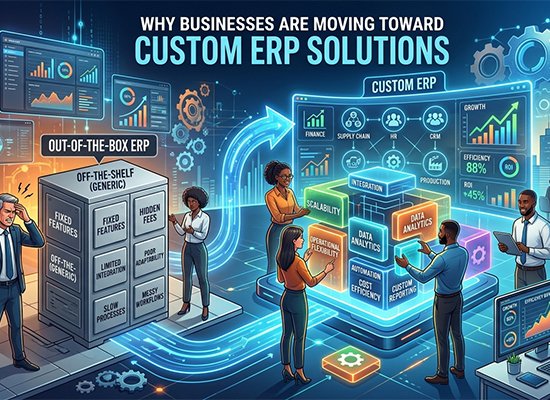
Standard ERP software provides general features designed for a wide range of businesses. However, it may not fully support specific workflows or industry requirements.
Custom ERP solutions provide:
- Complete flexibility
- Personalized features
- Better scalability
- Improved integration
- Greater control
- Enhanced security
For growing companies with unique requirements, customized ERP software offers a more effective approach compared to traditional solutions.
Best Practices for Successful ERP Implementation
To maximize the benefits of custom ERP development, businesses should follow these practices:
Define Clear Business Goals
Before development begins, companies should identify their operational challenges and expected outcomes.
Involve Employees
Including team members during planning ensures the system meets real workplace requirements.
Focus on User Experience
A simple and user-friendly ERP interface improves employee adoption.
Prioritize Security
Businesses should implement strong security measures to protect valuable data.
Plan Future Growth
The ERP system should be designed with future expansion in mind.
Why Businesses Choose Custom ERP Solutions
Companies are going to custom ERP solutions as they require software that is flexible, automated, and has full control over their processes.
As businesses grow in number, it is not enough to use the same old systems that drag down productivity. Integrated ERP solutions instead allow companies to better their performance, cut down on costs, and create a more robust base for growth.
Through proper ERP development services, companies may transform their operations and see better performance with technology-based solutions.
Final Thoughts
Custom ERP solutions are no longer a domain of large enterprises. Also growing businesses are adopting custom ERP software to improve efficiency, manage complex operations, and prepare for future growth.
By going into custom ERP software development, companies see a system that is tailored to their requirements. In terms of automation and integration to security and analytics, custom ERP solutions present the flexibility that today’s competitive market requires.
For businesses that wish to see efficiency in their operations and also report growth that is sustainable, a custom ERP system may be the answer.
 Frequently Asked Questions